


Search for this and the loudest phrase you will find is "suspended for no reason". It is worth taking that phrase seriously rather than dismissing it, because the people writing it are usually telling the truth about their own experience: they did nothing they considered wrong, and the shop went down anyway. Both things can be true at once. There is nearly always a reason, and it is frequently not a moral one.
The single most useful reframe is this. Most suspensions are administrative. A payment did not go through, a required detail was never confirmed, an account sat untouched for years, a bank account bounced a deposit. These are clocks, not judgements, and a clock does not care that your reviews are five stars. The smaller group of suspensions really is about conduct, and that group needs a completely different response. Sorting yours into the right group before you write to anyone is most of the work.
Nothing here is legal advice, and nothing here overrides what your own account says. Etsy revises these flows, and the reason and instructions shown on your own Policy violations page or in your own suspension email are the ones that govern your case.
Three buckets, three completely different responses
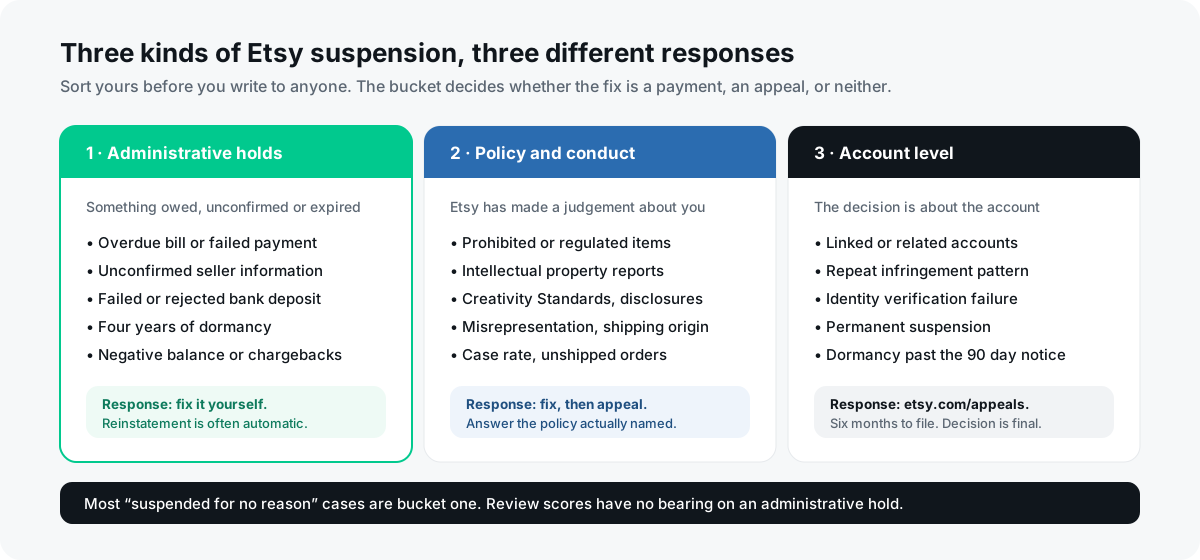
Every suspension reason on Etsy falls into one of three groups, and the group decides what you should do in the next hour.
- Administrative holds. Something owed, unconfirmed or expired. You usually fix these yourself, and reinstatement is often automatic rather than discretionary. Writing a heartfelt appeal here is wasted effort, because nobody is weighing your character.
- Policy and conduct suspensions. Etsy has made a judgement about what you sold, how you sold it, or how you handled buyers. These need a response: read the specific policy, fix the underlying issue, and reply to what was actually said.
- Account-level and structural suspensions. Linked accounts, repeat infringement, identity verification failures, permanent suspensions. These are the hardest, because the decision is about the account rather than a single listing, and some of them are final.
Bucket one: the administrative suspensions, and the clocks that trigger them
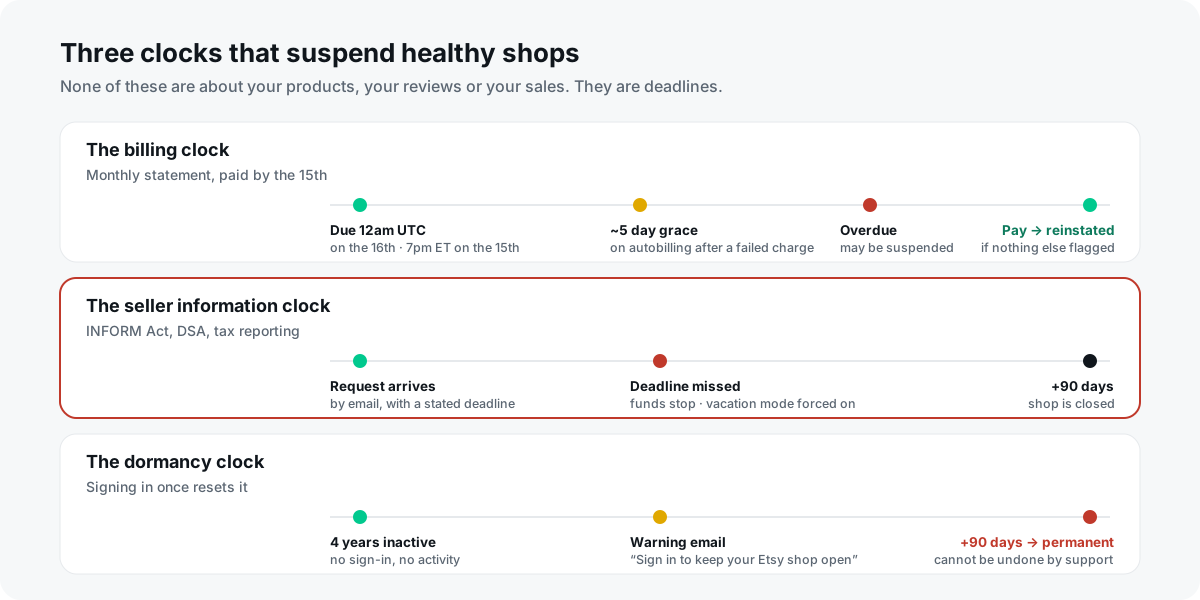
This is where most of the "no reason" suspensions live. Three clocks account for the bulk of them, and each has a published deadline you can plan around.
Clock one: an overdue Etsy bill
Etsy bills sellers monthly and expects payment by the 15th of the following month. Precisely, the payment must be received by 12:00am UTC on the 16th, which is 7pm US Eastern on the 15th. Miss that and the balance is overdue, and Etsy's own wording is that your account may be suspended. Sellers on autobilling get a grace period of about five days after a failed payment attempt before the account is affected.
The good news is that this is the most reversible suspension there is. Pay the outstanding balance and the account is reinstated automatically, as Etsy puts it, as long as there are no further causes for a suspension on your account. That qualifier is doing real work: if a bill was the only issue, paying it ends the story, but if something else was already flagged, clearing the balance will not lift the rest.
The trap most people hit is a stale card. An expired card, a card that hit its limit, a bank blocking an unfamiliar international charge, a currency conversion pushing a payment past an available balance. None of that is visible on your dashboard until the payment fails, which is why the fix is boring and preventive: check the card on file is current before the 15th of every month, and treat a failed-payment email as urgent rather than as noise.
Clock two: unconfirmed seller information
This is the one that genuinely blindsides people, because it has nothing to do with what you sell. Etsy periodically requires sellers to confirm their information to comply with law: the INFORM Consumers Act in the United States, the Digital Services Act in the EU, and various tax reporting obligations. You get a request with a deadline. Nothing about your shop has gone wrong.
Miss that deadline and the consequences escalate in stages. First you can no longer receive funds from your sales, and your shop is placed into vacation mode whether or not you chose it. Etsy is unusually blunt about the next part: the deadline is mandated by law, not decided by Etsy, and support agents cannot turn vacation mode off for you. Then, if the information is still not confirmed roughly 90 days past the deadline, the shop is closed.
Two practical implications. First, this is not an appeal situation, it is a form-completion situation, and no amount of explaining will substitute for submitting the information. Second, it means the email address on your Etsy account is load-bearing infrastructure. A confirmation request routed to an address you no longer check, or filtered into promotions, is how a healthy shop quietly runs out of time.
Clock three: dormancy
If an Etsy account has been inactive for four years or more, Etsy sends an email titled along the lines of sign in to keep your Etsy shop open. Sign in within 90 days and nothing happens. Ignore it and the account is permanently suspended, and Etsy states plainly that this cannot be undone by support. Notably, the person can still use the account to buy on Etsy, which is why some sellers discover the suspension only when they try to list again.
If you are sitting on a dormant second shop, a seasonal shop or an old account you might revive one day, that is the entire warning. Signing in once is enough.
Other administrative causes worth knowing
- A failed or rejected bank deposit. If Etsy cannot deposit your funds because the bank details are wrong, the account was closed, or the name does not match, payments stall and the account can be restricted until valid details are supplied.
- Identity verification at setup. Etsy uses a verification provider when you open a shop. If verification is denied, the shop does not open, and there is an appeal route for that decision specifically.
- Reserves and payment holds. These are not suspensions, but they feel like one. Etsy reserves the right to place a reserve on your funds, and new shops and shops with a sudden spike in sales commonly see a percentage of payments held for a period.
- Unresolved chargebacks or a negative balance. Money owed to Etsy from refunds, chargebacks or recouped fees behaves like an unpaid bill.
Bucket two: the policy and conduct suspensions
Here the response changes completely, because Etsy has made a judgement and you are answering it. The Seller Policy states that Etsy may suspend or terminate your account, and, importantly, any accounts Etsy determines are related to your account. That last clause is the source of a whole category of confusing suspensions, and it is covered in the third bucket.
The common triggers cluster into a handful of families.
- Prohibited items. Categories Etsy does not allow at all, or items that require a licence or documentation you do not hold. This includes things sellers do not expect, such as certain regulated goods, recalled products and items that violate applicable law in the destination market.
- Intellectual property. Selling items that use someone else's copyrighted characters, artwork, logos or trademarks. Etsy does not judge infringement itself, it acts on reports from rights holders, and repeat reports against one shop are treated more seriously than an isolated one.
- Creativity Standards. Reselling mass-produced goods as handmade, undisclosed production partners, undisclosed AI-generated work, or drop-shipped inventory presented as your own making. The disclosure failures are frequently unintentional, which does not make them less actionable.
- Misrepresentation. Inaccurate shipping origin, misleading photographs, false claims about materials or effects, or a shop identity that does not match who is actually behind it.
- Buyer experience failures at scale. Not shipping within your stated processing times, unresolved cases, and a case rate that stays high. Etsy can refund buyers for physical orders that were not shipped in time and recoup that money from you.
- Manipulating the platform. Fake reviews, shill purchases, keyword stuffing, and running duplicate shops to boost your own listings. Etsy names duplicate shops used for shilling explicitly.
If your suspension is in this bucket, the sequence that works is unglamorous. Find the exact policy named on your Policy violations page rather than the general category. Read it end to end, including the parts you assume do not apply to you. Fix the underlying problem across every listing, not just the one that was flagged, because a review that finds the same issue still live elsewhere is a review that goes badly. Then respond to what was actually said, briefly, in plain language, with dated records rather than adjectives. The mechanics of that response, including the file size limits and the one-appeal-per-listing rule, are covered in detail in our guide to appealing a removed Etsy listing.
Bucket three: account-level and structural suspensions
These are the ones that feel arbitrary and are the hardest to argue with, because the decision is about the account rather than about a listing.
- Linked accounts. If Etsy connects your new shop to a previously suspended account, through a shared device, IP address, bank account, card, address or email, the new shop can be suspended without you having done anything on it. This is why opening a fresh shop after a suspension so often fails within days.
- Repeat infringement. A pattern of intellectual property reports against one shop, rather than a single report, moves the case from listing level to account level.
- Identity or business verification failure. Where the information supplied cannot be verified, or does not match the account.
- Permanent suspension. The email says permanently suspended in the subject line and the body. This has its own route: the Appeals Centre at etsy.com/appeals, a six month window to submit, and a decision Etsy describes as final.
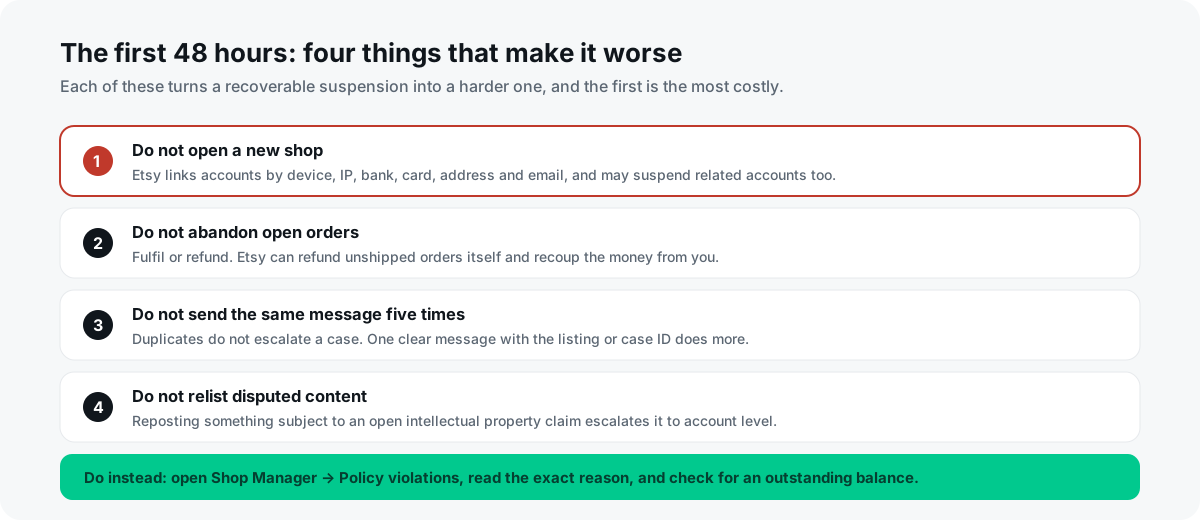
On the linked-accounts point, the practical advice is the opposite of the instinct. The instinct after a suspension is to open a new shop quietly and carry on. That is the single fastest way to convert a recoverable situation into a permanent one, because a second shop discovered after a suspension reads as evasion, and it can take down the original appeal along with the new shop.
What you can and cannot do while suspended
This part is badly documented in most guides and matters enormously in the first 48 hours, because your existing buyers are still waiting for orders and their experience is part of what gets reviewed.
- You must still complete open orders, either by fulfilling them or by refunding the buyer. Walking away from them makes everything worse.
- You cannot buy Etsy shipping labels while suspended. Buy postage directly from the carrier instead, and add the tracking manually where you can.
- You cannot use the Etsy Seller app while suspended. Use the browser.
- Etsy may refund buyers directly for physical orders that were not shipped within your stated processing times, and recoup that amount from you.
- Your funds may be held. Etsy can place a reserve, and an outstanding balance owed to Etsy will be taken from incoming payments.
How long does a suspension last
It depends entirely on the bucket, which is why a single number is never a useful answer.
- An overdue bill: resolved as soon as the payment clears, and reinstatement is automatic if nothing else is flagged.
- Unconfirmed seller information: resolved when you submit the information, though funds and vacation mode stay restricted until it is processed, and the shop closes at roughly 90 days past the deadline.
- A policy suspension with an appeal route: Etsy targets around three days for a listing appeal review and allows up to 10 to 12 business days, and account-level reviews can run longer.
- Permanent suspension: there is a six month window to file at etsy.com/appeals, and the decision on that appeal is final.
The preventive version of this article
Almost everything above is cheaper to prevent than to appeal, and the preventive work takes about twenty minutes a quarter.
- Confirm the payment card on file is current, and calendar a check before the 15th of each month.
- Confirm the email address on your Etsy account is one you actually read, and that Etsy mail is not being filtered away. Legal confirmation requests arrive there and the deadline runs whether you saw it or not.
- Keep bank details current, especially after switching banks or changing a business name.
- Audit your listings for the two disclosures that catch honest sellers out: production partners, and AI-generated work.
- Keep dated records of how your work is made, created at the time rather than reconstructed afterwards. Source files, drafts, in-progress photographs, materials receipts, order records.
- Sign in to any dormant shop at least once a year.
- Keep processing times honest. A padded processing time costs a small amount of conversion and prevents a category of case that is genuinely hard to recover from.
The record-keeping point is the one people skip, and it is the one that decides appeals. Evidence created after a removal always looks like evidence created after a removal. Evidence with original dates on it, sitting in order, does not. That is exactly what the Etsy Listing Appeal Evidence Kit was built to make routine rather than heroic: a structure for keeping dated proof of your process as you work, so that the day you need it you are assembling a folder rather than reconstructing a year.
Get the Etsy Listing Appeal Evidence Kit →Why does my Etsy account keep getting suspended?
Repeated suspensions usually point at an account-level cause rather than a listing-level one. The most common are a linked account: Etsy connecting your shop to a previously suspended account through a shared device, IP address, bank account, card, address or email, and an unresolved administrative issue such as an unpaid balance or unconfirmed seller information that gets re-flagged each cycle. A pattern of intellectual property reports also escalates from listing level to account level.
How do I fix a suspended Etsy account?
Start by identifying which kind of suspension it is. Check Shop Manager for an outstanding balance, check for an unanswered request to confirm your seller information, and open the Policy violations page to see whether a specific policy is named. Administrative causes are fixed by paying or submitting, and reinstatement is often automatic. Policy causes need you to fix the underlying issue and respond to the specific policy named. Permanent suspensions go through etsy.com/appeals.
How long does an Etsy suspension last?
There is no single figure. An unpaid bill is resolved as soon as the payment clears, and Etsy reinstates the account automatically as long as nothing else is flagged. An unconfirmed seller information hold lasts until you submit the information, and the shop closes at roughly 90 days past the deadline. Listing appeals are usually reviewed in about three days, with up to 10 to 12 business days allowed. A permanent suspension has a six month appeal window and a final decision.
Can I make another Etsy account if I am suspended?
Opening a new shop after a suspension is the most reliable way to make the situation permanent. Etsy's Seller Policy allows it to suspend or terminate your account and any accounts it determines are related to yours, and it links accounts through shared devices, IP addresses, bank accounts, cards, addresses and email. A new shop discovered after a suspension reads as evasion and can take down your appeal on the original.
Why would an Etsy account be suspended as a buyer?
Buyer-side suspensions are usually about payment or abuse patterns rather than policy: unpaid balances or chargebacks, a card or bank detail that keeps failing, a high rate of disputes or refund requests, or activity that looks like it is manipulating the platform, such as buying from your own or a connected shop. Note that a dormant seller account that gets permanently suspended can often still buy, which is why some people discover the suspension only when they try to list again.
Can Etsy suspend a shop with good reviews and no violations?
Yes, and this is the source of most "suspended for no reason" posts. Review scores have no bearing on the administrative causes. An overdue bill, an unconfirmed legal information request, a failed bank deposit, four years of dormancy or a link to another suspended account will suspend a five-star shop exactly as fast as a one-star shop.
Do I still have to ship orders while my Etsy shop is suspended?
Yes. You are expected to complete open orders by fulfilling or refunding them. You cannot buy Etsy shipping labels while suspended, so buy postage directly from the carrier, and you cannot use the Etsy Seller app, so work in a browser. If orders are not shipped within your stated processing times, Etsy may refund the buyer and recoup that money from you.
What happens if I miss the deadline to confirm my seller information?
You stop being able to receive funds from your sales and your shop is placed into vacation mode. Etsy states that the deadline is mandated by law rather than set by Etsy, and that support agents cannot turn vacation mode off for you. If the information is still not confirmed roughly 90 days past the deadline, the shop is closed. Submitting the requested information is the only route.
One caveat that applies to every figure above: Etsy revises these policies, deadlines and routes, and this reflects what Etsy publishes as of August 2026. The reason and instructions shown in your own account always take priority. If you are reading this before anything has gone wrong, the twenty-minute preventive list is worth more than the rest of the article combined.