


The single loudest thing in Etsy seller communities right now is packaging compliance, and most of the panic comes from one belief: that every seller shipping into Europe has to register separately in all twenty-seven member states, at thousands of euros a year, or stop selling to the EU entirely.
That belief is wrong in its details and right in its direction, which is the worst possible combination. It is worth separating the two.
The short answer
Extended Producer Responsibility is a national obligation, not an EU-wide one. You register in the countries you actually place packaged goods on the market in, not in all of them. For most small shops that is a handful of countries, not twenty-seven. And you only register in a country once you are genuinely selling into it.
The part people are right about: Etsy does not do this for you. Etsy's own help pages for Germany and France both put the obligation on the seller and then ask you to hand your registration number over to them.
What Etsy actually asks for
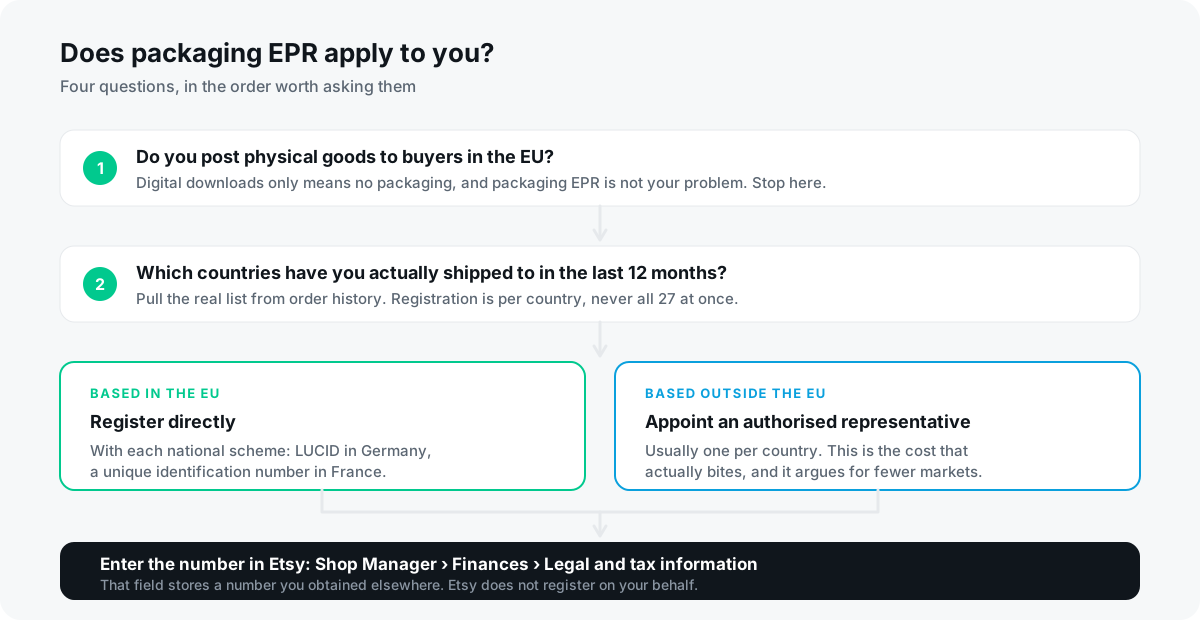
Open Shop Manager and go to Finances, then Legal and tax information, then Extended Producer Responsibility (EPR) Registrations. That field is where Etsy expects your national registration numbers to go. It is a box for a number you obtained elsewhere. It is not a registration service.
- Germany: you register with the LUCID packaging register before placing packaged goods on the German market, then enter the number in Shop Manager.
- France: you obtain a unique identification number per relevant product category, via the national scheme, and enter that.
- Other member states run their own registers, with their own fees, reporting periods and thresholds.
Etsy's guidance on both pages ends with a recommendation to consult a qualified legal or compliance professional. That is not Etsy being unhelpful, it is Etsy declining to be your compliance advisor, which is a meaningfully different thing.
Why the fee numbers being quoted are usually wrong
The figures circulating in seller groups are almost always the ones a compliance service quotes for full multi-country coverage, or the ones a mid-sized company pays. EPR fees are typically weight-based: they are calculated on how much packaging material you actually put on that country's market in a year.
A shop posting a few hundred small parcels a year is placing a very small tonnage of cardboard and paper on any single market. The registration and scheme admin costs are usually the real number, not the material fees. That does not make it free, and it does not make it optional, but it is a different order of magnitude from the figures being repeated.
The authorised representative problem
If you are based outside the EU, most member states will not let you register directly. You need an authorised representative established in that country to carry the obligation on your behalf. This is the cost that actually bites for US, UK and other non-EU sellers, because it is a per-country service fee that exists whether you ship one parcel or a thousand.
It is also the reason the honest advice for a very small non-EU shop is sometimes to concentrate on one or two EU countries rather than shipping everywhere. Fewer markets means fewer representatives.
Work out whether this is even your problem
- Do you ship physical goods to buyers in the EU? If you sell only digital downloads, packaging EPR is not about you.
- Which specific countries have you actually shipped to in the last twelve months? Pull the list from your order history rather than guessing. Most sellers are surprised how concentrated it is.
- Are you inside the EU or outside it? Inside, you generally register directly. Outside, you generally need a representative in each market.
- How much revenue does each of those countries represent? A country producing three orders a year is a candidate for switching off, not for a compliance budget.
The reasonable middle path
Sellers are doing one of three things right now: registering properly in their top one or two EU markets, restricting shipping to the countries they can cover, or ignoring it and hoping. The third is the one that ends with delisted products, because marketplaces are increasingly being pushed to check registrations rather than take a seller's word.
The first two are both defensible. Which one is right depends entirely on what EU sales are actually worth to you, and that is a margin question before it is a legal one.
Does Etsy register for EPR on my behalf?
No. Etsy's help pages for Germany and France both place the obligation on the seller and provide a field in Shop Manager under Finances, then Legal and tax information, for you to submit your own registration numbers.
Do I have to register in all 27 EU countries?
No. EPR registration is per country and applies where you actually place packaged goods on the market. Most small shops sell meaningfully into only a few EU countries, and those are the ones to address.
Is there a minimum sales threshold before EPR applies?
There is no single EU-wide threshold. Some national schemes and some product categories have turnover thresholds, but packaging obligations commonly apply from the first unit placed on the market, so it is safer to assume no threshold unless a specific national scheme says otherwise.
What happens if I ignore EPR entirely?
The realistic near-term risk for a small seller is not a fine but delisting: marketplaces are being required to verify that sellers are registered, and sellers who cannot provide a number risk losing their listings in that market.
I only sell digital downloads. Does this apply to me?
Packaging EPR does not, because there is no packaging. If you never post a physical object to an EU buyer, this particular set of rules is not your problem.
Before you spend anything on compliance for a market, it is worth knowing what that market is actually earning you after Etsy's cut. That is a smaller number than most sellers assume.
Check your real take-home per sale →