


A listing disappears. The email is short and generic, the Policy violations page names a policy you have never read end to end, and a box on screen is asking for supporting documents. The instinct is to write something straight away, attach whatever is on the desktop, and hope. That instinct is the most expensive mistake in this entire process, because on most removals you get exactly one appeal, and once it has been denied Etsy will not look at that listing again.
Nothing here is legal advice, and nothing here overrides your own account. Etsy revises these flows regularly, and the reason, route and deadline shown on your own Policy violations page always take priority over any general guide, including this one. What this guide does is separate four processes that look identical from the outside and are not interchangeable, and then explain what actually goes into a response.
Step one: work out which of five things actually happened
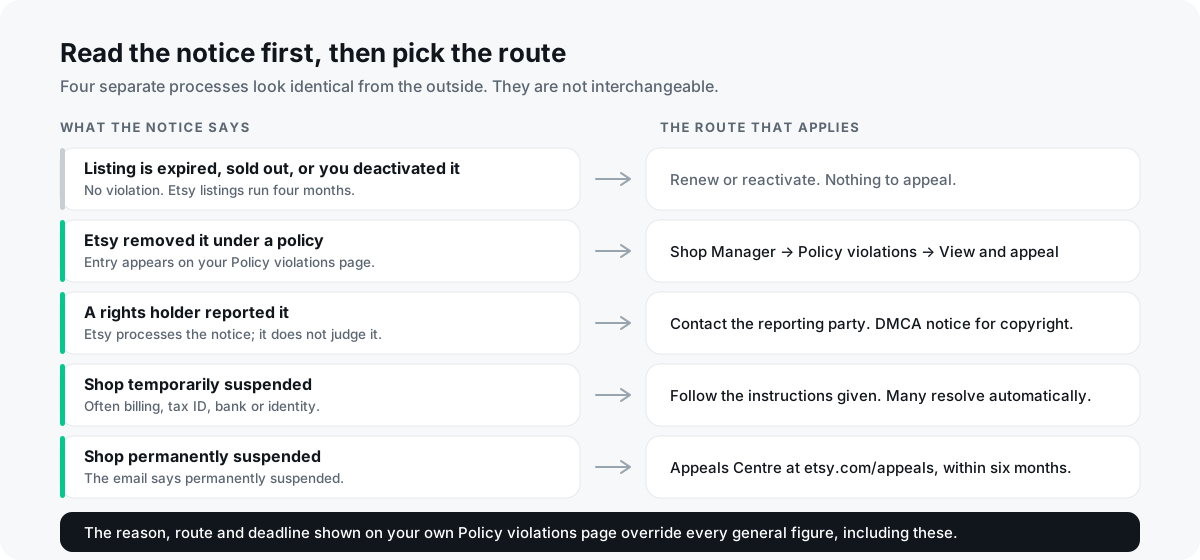
Sellers routinely respond to the wrong process. Etsy runs separate machinery for listing removals, intellectual property reports, temporary suspensions and permanent suspensions, and a listing that has simply gone inactive is not a violation at all. Getting this wrong wastes the one response you had.
- Nothing enforcement-related happened. An Etsy listing stays active for four months. If it did not sell in that window and auto-renew was off, it expired. Sold-out listings and ones you deactivated yourself also sit under Inactive. Check this first, because it is the most common false alarm.
- Etsy removed the listing under one of its policies. There is an entry on your Policy violations page naming the policy, and depending on the policy there may be an appeal route attached to it.
- A rights holder submitted an intellectual property report. This is not an Etsy judgement about your product, and it is not resolved through the ordinary listing appeal.
- Your shop is temporarily suspended. Etsy tells you what to fix, and a fair number of these are administrative rather than about your products at all.
- Your shop is permanently suspended. The words permanently suspended appear in the email subject line and body. This has its own appeal route, its own deadline and its own form.
Where the real notice lives
The email is a summary. The record is in Shop Manager, under Policy violations. Open the entry for the specific listing and read it literally rather than skimming for the gist, because the difference between two removals that feel the same is usually a single line on that page.
- The exact policy named. Creativity Standards and Counterfeit and Unauthorized Reproduction are different accusations and need different evidence.
- The listing ID, and the removal or case ID. You will need these to keep multiple removals apart.
- The Appeal status. If appeals are not open for that policy yet, this says Not available.
- The deadline shown in your account, which governs regardless of any general figure.
- The literal instruction or reason text. Copy it out word for word before you start writing anything, so your response answers what was actually said rather than what you assumed.
The listing appeal, by the numbers
Etsy publishes the mechanics of the listing appeal, and the specifics matter more than the general advice does.
- The window: unless stated otherwise, you have 180 days from the time Etsy removed the listing to submit an appeal.
- The path: sign in, go to Shop Manager, open Policy violations, select View and appeal, then Start an appeal.
- The attachments: appeals for listings removed under Creativity Standards, Counterfeit and Unauthorized Reproduction, or the Adult Nudity policy can include up to 12 photos, videos or supporting documents.
- The file floor: any photo or document you attach must be larger than 120KB. This is a minimum, not a maximum, and it catches people out.
- Video: three minutes or less, 500MB maximum per file. Timelapse footage is explicitly acceptable, which is a strong hint about what Etsy finds persuasive for handmade work.
- One shot: once an appeal is denied, you cannot submit another appeal for that same removed listing. Appeals are submitted per listing, not per shop.
- The wait: most reviews are completed within about three days, but Etsy allows up to 10 to 12 business days.
- The outcome: if the appeal is approved, the listing is restored and available for sale again.
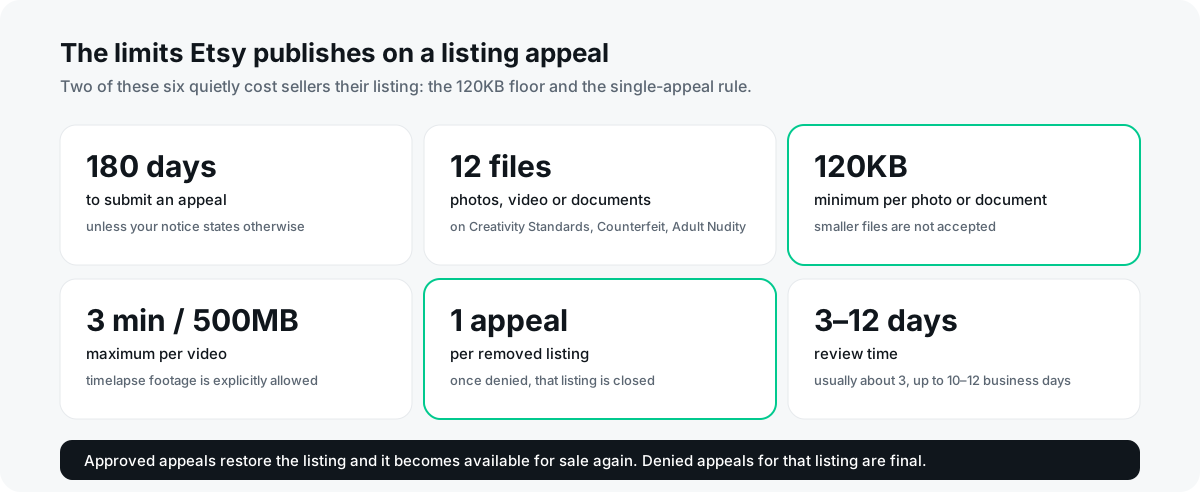
That 120KB floor deserves a sentence of its own. A screenshot pasted into a document, exported at web quality and run through a compressor can easily land at 60 or 80KB, and a heavily compressed photo of a workbench is exactly the kind of file a seller submits in a hurry. Check the file size of every attachment before you upload it, and keep photographs at their original resolution rather than resizing them down to be polite.
Why the appeal button says Not available
This is the question that fills seller forums, and the answer is duller than the panic suggests. Etsy has been extending listing appeals to more policies and more sellers over time rather than switching them on everywhere at once. If appeals are not yet available for the policy your listing was removed under, the Appeal status on the violation entry reads Not available. It is a coverage gap in the rollout, not a verdict on your shop, and it is not something a support message converts into an appeal.
What it does mean, practically, is that the useful work shifts. Preserve the records now, while they still exist and while the dates on them are still original, so that if a route opens or the same issue recurs on another listing you are not reconstructing history from memory.
The four policy families a removal comes from
Etsy removes listings that do not follow its Creativity Standards, its Prohibited Items policy, its Sanctions policy or its Intellectual Property policy, and listings must also comply with applicable law. Knowing which family you are in decides what evidence is even relevant.
One removal type is worth calling out because it is not really an appeal situation at all: a listing pulled for mature content in the thumbnail. Etsy's guidance there is to create a new listing that follows the disclosure rules, with a family-friendly first image and the mature content removed, obscured or cropped in that thumbnail. Arguing the point is slower than relisting correctly.
What Creativity Standards actually asks you to prove
Most removals that sting are in this family, because the accusation is implicitly about whether you made the thing. Etsy's Creativity Standards recognise four ways an item can qualify, and the evidence that helps you depends entirely on which one you are claiming.
- Made by a seller: physical items you handcraft, hand-alter or hand-assemble, including work produced on your own computerised tools such as a 3D printer or laser cutter from your own designs.
- Designed by a seller: your original designs sold as digital downloads, produced by an approved production partner with the required disclosure, or created with an AI image generator from your prompts, with AI use disclosed in the listing description.
- Handpicked by a seller: vintage items at least 20 years old, one-of-a-kind natural items you found, or genuinely curated gift sets drawing on more than one source rather than a bulk resale.
- Sourced by a seller: craft supplies, party goods, and buyer-personalised items produced by a partner using the customer's own text or images.
Two disclosure rules sit inside those categories and cause a lot of avoidable trouble. If an item was created using AI, that has to be disclosed in the listing description. If an item is made by a production partner, that has to be disclosed too, along with accurate information about where the item ships from. A removal is a bad moment to discover a listing was missing a disclosure, and it is worth auditing your other listings for the same gap the same week.
Etsy is also explicit that it may ask for additional photo documentation or information, for example about a vintage item's source, age, designer or materials. That sentence is the clearest published signal of what an evidence request looks like: specific, documentary, and about provenance rather than opinion.
The evidence that carries weight
Reviewers are not weighing how upset you are or how long you have been on the platform. Useful evidence has four properties: it is dated, it was created at the time rather than assembled afterwards, it is specific to the listing in question, and every piece agrees with every other piece and with your own listing copy.
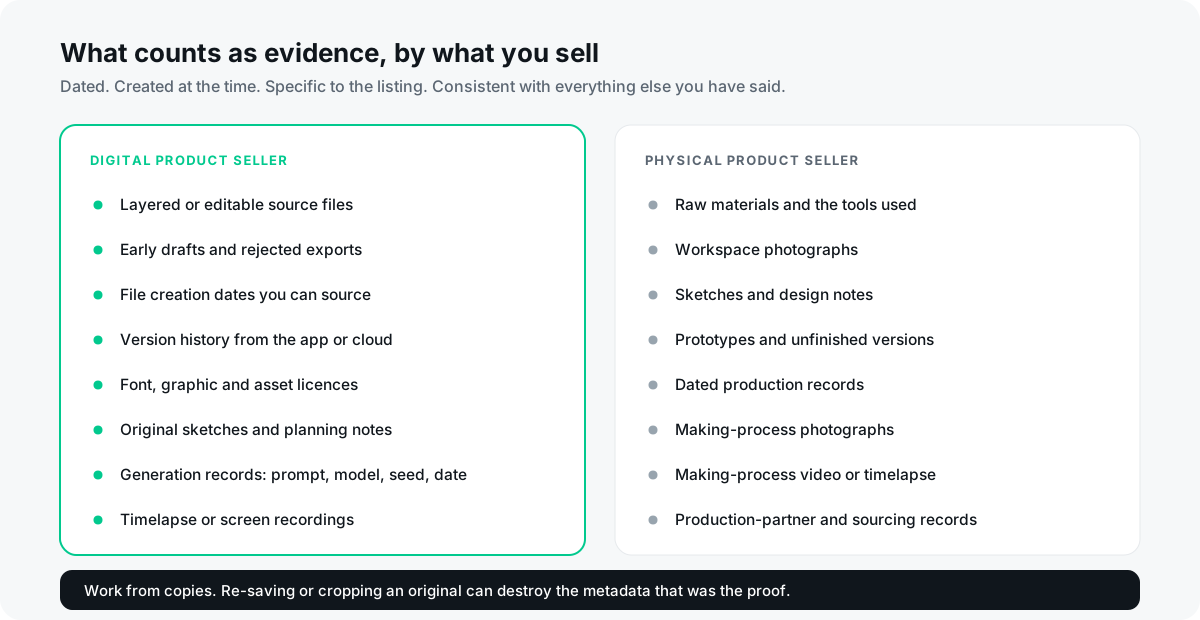
For a digital seller, the strongest material is the stuff you would normally throw away: the layered working file rather than the flattened export, the ugly first draft, the version history, the licence receipts for the fonts and assets you built on, and the original sketch or planning note. Where AI was part of the process, the generation record, including prompt, model, seed and date, is a document rather than an excuse, and it pairs with the disclosure that should already be in the listing.
For a physical seller, the equivalent is the process itself: raw materials and tools, the workspace, the prototype that did not work, the half-finished piece on the bench, the dated production record, and the in-progress photographs and video that no reseller would have. This is precisely why Etsy permits timelapse video in appeals. A three-minute timelapse of a piece being made is a far stronger document than three paragraphs asserting that you made it.
If you work with a production partner, the correspondence and sourcing records are the evidence, and they need to line up with what your listing already says about who makes the item and where it ships from.
The mistakes that sink appeals
- Guessing a date. If you cannot show where a date comes from, leave it out. One unsupported claim undermines the documents that were solid.
- Editing the originals. Re-saving, cropping or converting a source file to tidy it up can destroy the very metadata that made it proof. Work from copies and leave the originals untouched.
- Building the record after the notice. Evidence created this week to explain work from last year reads exactly like what it is.
- Filling all 12 slots because 12 are available. A focused set of four relevant documents beats a dozen loosely related ones, and irrelevant attachments invite scrutiny you did not need.
- Contradicting your own listing. If the appeal describes a production partner the listing never disclosed, you have documented a second problem while trying to fix the first.
- Sending one generic paragraph through several unrelated channels. A listing appeal, a suspension appeal and a message to a rights holder are different audiences with different questions.
- Leaving private information in the attachments. Redact anything that identifies a customer or that you would not want stored in a case file.
- Reusing one appeal text across several removed listings. Appeals are decided per listing, and a generic response answers none of them well.
Intellectual property reports are a different animal
If your listing came down because a rights holder reported it, the situation is structurally different. Etsy does not make decisions about which listings infringe intellectual property and cannot speak on behalf of the rights holder. It processes notices. That is why arguing the merits with Etsy support tends to go nowhere.
- Etsy's own guidance is to contact the party that submitted the report directly if you have questions about the claim, and to consider speaking to an attorney about the dispute.
- Do not create new listings for the same content until the issue is resolved with the other party. This is the step that turns one removed listing into an account-level problem.
- Repeat reports of infringement may result in the loss of account privileges, which is the real risk hiding behind a single takedown.
- A retraction from the reporting party is a legitimate route, and it comes from them, not from Etsy.
A DMCA counter notice exists, and it is a serious instrument rather than a form. It applies to copyright claims only; Etsy cannot accept counter notices for non-copyright claims. It requires a statement, under penalty of perjury, that you have a good faith belief the material was removed as the result of a mistake or misidentification. The counter notice is shared with the complaining party and includes your contact information. If it is processed and the other side does not go to court, the item can be restored after about 10 business days. Etsy notes plainly that the complaining party may choose to file legal action against you. If you have read our guide on what happens when someone copies your listing photos, this is the same machinery viewed from the other end of the telescope.
Suspensions: temporary and permanent are not the same word
A temporary suspension comes with instructions, and a surprising share of them are administrative rather than about your products. Common causes include an overdue bill, a missing taxpayer ID for US sellers, unverified bank details, an unanswered identity verification request, or seller information waiting to be confirmed in Shop Manager. Some of these reinstate automatically once resolved, which is a very different exercise from writing an appeal.
While suspended you keep limited access: you can view and pay bills, complete existing orders and add tracking, and issue refunds. You cannot receive new orders or create listings, and funds in your Etsy Payments account are being reserved. Completing the orders you already owe is worth doing regardless of how the rest of it resolves.
A permanent suspension is its own process. The words permanently suspended appear in the email. The appeal is filed through the Appeals Centre at etsy.com/appeals, signed in with the suspended account, and you have six months from the suspension to file. Etsy asks you to resolve the underlying issues first, then to describe the actions you have taken and how your practices will change. A specialist reviews the appeal and your account history and responds by email within up to two weeks. Submitting an appeal does not guarantee reinstatement, and if it is denied, that decision is final.
A working order of operations
- Read the exact notice in your account rather than the email summary, and copy the wording out verbatim.
- Identify which of the five situations you are in before writing a single sentence.
- Confirm the response route currently available to you, and the deadline your account displays.
- Preserve everything now: original files untouched, correspondence, screenshots of the listing and the violation entry with IDs visible.
- Build the dates first. For each one, record where it comes from, and find your earliest date you can actually evidence.
- Assemble evidence for one listing at a time, choosing relevance over volume.
- Write the response so it answers the specific policy named, in plain language, with the documents referenced by name.
- Check every attachment: over 120KB, readable, relevant, and free of private information.
- Submit, then save a complete copy of exactly what you sent and when.
- Audit your remaining listings for the same issue, particularly missing AI or production-partner disclosures, before it happens again.
What none of this guarantees
An organised, evidenced, policy-specific appeal is a better appeal than a panicked one. It is not a guarantee. Etsy decides, appeals are denied for reasons that are never fully explained, and no template, service or guide changes that. Anyone promising reinstatement is selling you certainty they do not have.
What you can control is whether the records exist, whether the dates are provable, whether your response answers the actual accusation, and whether you understood which process you were in. That is the part that is genuinely in your hands, and it is also the part most sellers get wrong under pressure.
Doing that under pressure, from scratch, at eleven at night, is the hard version. We built Tracefolio for the other version: a two-edition evidence kit, one for digital sellers and one for physical sellers, with a case diagnosis planner that makes you write down the policy, IDs, appeal status and deadline before you respond, a date worksheet that forces every date to have a source, a seven-page evidence pack template, editable response templates, and a worked example of what a finished dossier looks like. It organises records you already have. It does not create evidence, submit anything for you, or promise an outcome.
Get the Etsy Listing Appeal Evidence Kit →Why was my Etsy listing removed?
Etsy removes listings that do not follow its Creativity Standards, Prohibited Items policy, Sanctions policy or Intellectual Property policy, and listings must also comply with applicable law. The specific reason is on the Policy violations page in Shop Manager, and it is more precise than the email summary.
How long do I have to appeal an Etsy listing removal?
Unless stated otherwise, 180 days from the time the listing was removed. Your own Policy violations page shows the deadline that actually applies to your case, and that figure takes priority.
Why does my Appeal status say Not available?
Etsy has been rolling listing appeals out to more policies and more sellers gradually rather than all at once. If appeals are not yet open for the policy your listing was removed under, the status reads Not available. It is not a judgement about your shop and support cannot convert it into an appeal.
My Etsy appeal was denied. Can I appeal again?
Not for the same listing. Once an appeal is denied you cannot submit another appeal for that removed listing. This is why the first submission has to be the good one.
How long does an Etsy listing appeal take?
Most reviews are completed by a specialist within about three days, but Etsy allows up to 10 to 12 business days. You are notified by email, and a banner appears in Shop Manager with the decision.
What evidence should I send with an Etsy appeal?
Records that are dated, were created at the time, are specific to that listing, and agree with each other and your listing copy. For digital work that means layered source files, drafts, version history and asset licences. For physical work it means materials, workspace, prototypes, dated production records and in-progress photographs or timelapse video. Photos and documents must each be larger than 120KB, and appeals for certain policies allow up to 12 files.
A rights holder reported my listing. Is that the same as a policy removal?
No. Etsy does not decide which listings infringe and cannot speak for the rights holder, so the ordinary listing appeal is not the route. Etsy's guidance is to contact the reporting party directly, and a DMCA counter notice exists for copyright claims specifically. Do not relist the same content while the dispute is open.
Can appealing make things worse?
A truthful, relevant appeal is not itself a risk. What creates risk is contradicting your own listing, submitting fabricated or altered material, relisting content that is subject to an open intellectual property dispute, or filing a DMCA counter notice without understanding that it shares your contact details with the complainant and can invite legal action.
One caveat that applies to every figure above: Etsy revises these policies, routes and deadlines, and this reflects what Etsy publishes as of August 2026. Before you act, check the instructions displayed in your own account, because those are the ones that govern your case.