


Sellers ask how many IP strikes Etsy allows, hoping for a number they can plan against. There is not one, and the absence is deliberate. Etsy's Intellectual Property Policy commits only to this: Etsy terminates selling privileges of members who are subject to repeat or multiple notices of intellectual property infringement, in appropriate circumstances and at Etsy's discretion.
Read that sentence for what it does not say. Not a count. Not a window. Repeat or multiple, in appropriate circumstances, at Etsy's discretion. The seller help page is no more specific: repeat reports of infringement may result in the loss of account privileges. There is no threshold to run up to, which means the only safe assumption is that the second report is already inside the zone where discretion applies.
This is about the escalation itself: what changes between one report and several, why shops that fix the named listing still go down, and the one move that reliably converts a survivable situation into a permanent one. Nothing here is legal advice, and the instructions in your own notice govern your case.
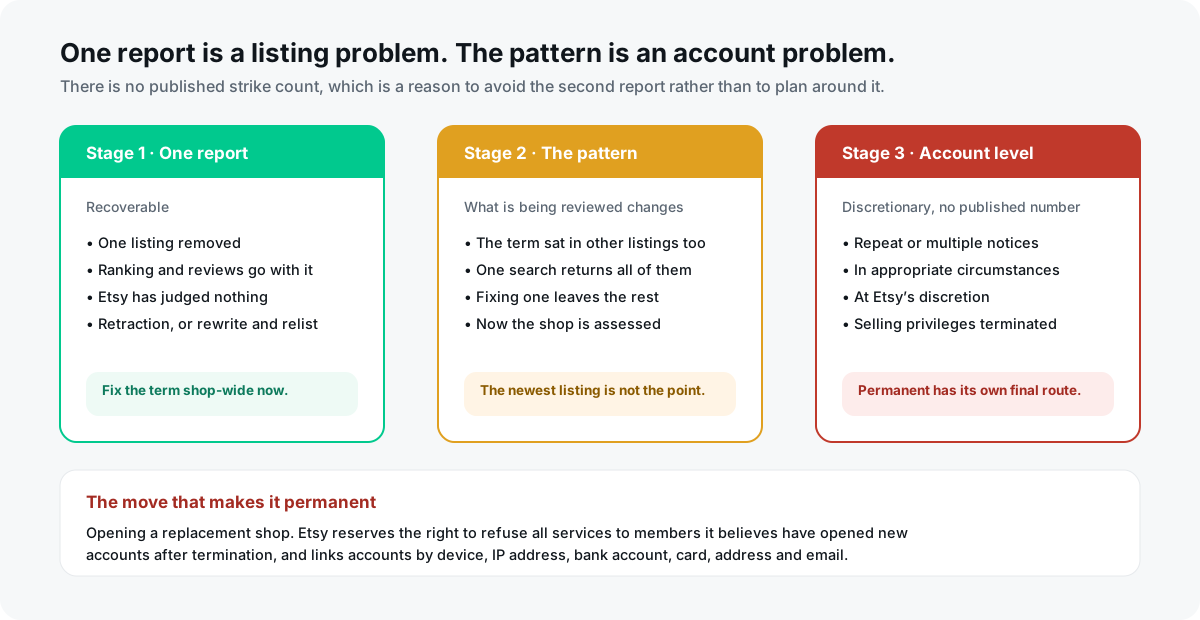
Stage one: a single report, and a listing goes
A rights holder files. The listing is removed or disabled. You get an email containing the contact information of the party who filed it. Nothing has happened to your account.
What you lose is the listing and everything attached to it: its position in search, its favourites, its review history and whatever ranking it had accumulated. That is a real cost and it is a listing-level cost. At this stage the situation is entirely recoverable, and the two routes are a retraction from the reporting party or a rewrite without the reported term. Neither of them is an appeal to Etsy, because Etsy does not judge these: it says it is not in a position to make legal determinations whether a shop's content infringes.
The reason this stage matters so much is that almost everyone treats it as an isolated event. It rarely is.
The multiplier nobody accounts for
Here is the mechanic that turns one report into five, and it is the single most useful thing on this page.
You did not put that term in one listing. You put it in a tag, and then you copied that tag block into every listing in the line, because that is how anyone with forty listings works. The reporting party did not find your listing by browsing. They ran a search for their mark, and the search returned everything of yours carrying it.
So when you fix the named listing and stop, you have removed one of the search results. The rest are still there, still returned by the same search, and the next sweep files against them. From Etsy's side that is not one seller who made a mistake and corrected it. It is a shop generating repeated notices, which is the exact phrase the policy attaches termination to.
Stage two: the pattern, and what changes about you
At two or three reports the object under review stops being a listing and starts being a shop. This is a qualitative change, not a quantitative one, and it changes what evidence is even relevant.
At stage one the question is whether one listing used one term. At stage two the question is whether this shop has a habit. Everything that was previously background becomes evidence: how many other listings carry brand terms, whether the shop name itself references someone else's mark, whether previously removed material reappeared, how quickly earlier reports were acted on.
This is why the seller instinct at stage two is exactly wrong. The instinct is to defend the newest listing, because that is the one that just went down. What actually matters is demonstrating that the pattern has stopped, which means the sweep across everything else you own, done before anybody asks.
Stage three: account level, and what that email looks like
At account level the wording changes. You are no longer reading about a listing. Suspension notices reference the account, and Etsy's Seller Policy allows it to suspend or terminate your account and any accounts it determines are related to your account.
Two features of this stage catch people out. The first is that account-level IP decisions do not have the same appeal shape as ordinary policy removals, because the underlying reports were never Etsy's determination to begin with. The second is that a permanent suspension has its own separate route, a submission window at etsy.com/appeals and a decision Etsy describes as final. The full map of what suspension type you are holding and which route each one takes is in why Etsy suspends shops.
The move that makes it permanent
Opening a new shop. This is the single most reliable way to turn a bad month into the end of the business, and it is the most common thing sellers do, because it feels like the practical response.
Etsy's Intellectual Property Policy addresses it directly: Etsy reserves the right to refuse all services to members it believes have opened new accounts after termination. Accounts are linked by shared devices, IP addresses, bank accounts, cards, addresses and email, so a second shop opened on the same laptop with the same bank details is not a fresh start, it is an additional data point in the same file. Worse, a replacement shop found while an appeal on the original is open reads as evasion and can sink the appeal you still had.
The correct move at every stage is the boring one: fix the actual shop, in place, under the account that has the history.
What to do in the first day, in order
- Read the notice and identify the exact term. Not the general category, the specific word or phrase that was reported. Everything downstream depends on it.
- Establish whether it was trademark or copyright. They arrive the same way and have completely different routes, and pursuing the wrong one costs a week.
- Search your own shop for that term before you do anything else. Titles, all 13 tags per listing, descriptions, attributes, variations, personalisation prompts, image text, shop sections and the About page.
- Remove it everywhere it appears, including from listings nobody has reported yet. This is the step that decides whether you stay at stage one.
- Consider contacting the reporting party about a retraction, briefly and specifically. Their contact details are in your notice.
- Do not relist the reported content unchanged, and do not open a second shop.
- Write down what you removed and when, with dates. If a pattern conversation happens later, a dated record of the sweep is the difference between asserting you fixed it and showing it.
Why the second report costs so much more than the first
It is worth being concrete about the economics, because sellers systematically under-price this risk.
One report costs a listing: its ranking, its reviews, its favourites, and the traffic it was carrying. Painful, contained, rebuildable. A termination costs the shop's entire review history, its search position across every listing, its favourites, its repeat buyers, its shop age and the account itself, and Etsy's linking behaviour means you cannot simply start again cleanly under the same roof.
Those are not the same order of magnitude, and the thing separating them is usually a tag block sitting in listings nobody has looked at since they were written. That is the whole argument for a sweep: not that the risk of any one term is high, but that the downside is asymmetric and the fix is deleting words that were not earning anything.
The sweep, and why it is not a weekend job
The work itself is not complicated, it is just long. Forty listings is forty titles, five hundred and twenty tags and forty descriptions. Each candidate term needs the register searched in the right places, dead records filtered out, the goods and services description actually read rather than the class number glanced at, and the owner identified, because a mark held by an operation that runs automated sweeps behaves nothing like one held by a dormant sole trader. Then every flagged listing needs a replacement title and a fresh 13 tag set that does not just move the problem to a different word.
That is the entire content of the Etsy trademark check. Every title, tag and description screened against the marks that are actually enforced on Etsy, anything unfamiliar verified live against USPTO and TMview, each flagged listing returned with the exact word that triggered it, who owns the mark, in which class, and whether it is one that gets enforced, plus a replacement title and 13 tag set written for it. The terms that came back clear are listed as well, so you know what was checked rather than just what failed. It runs from EUR 59, scaling by listing count to EUR 149.
Set that against what a termination costs and the arithmetic is not close. It is also worth doing when nothing has gone wrong, which is the only time it is genuinely cheap.
Sweep the shop before the second report →How many IP strikes before Etsy suspends a shop?
Etsy does not publish a number. The Intellectual Property Policy says Etsy terminates selling privileges of members who are subject to repeat or multiple notices of intellectual property infringement, in appropriate circumstances and at Etsy's discretion, and the help page says repeat reports may result in the loss of account privileges. Because there is no published threshold, the working assumption has to be that the second report is already inside the range where discretion applies.
Can one trademark complaint get my Etsy shop suspended?
A single report normally removes the listing rather than the shop. The account-level risk comes from the pattern. The trap is that one reported term usually sits in many listings, because tag blocks get copied across a product line, so fixing only the named listing leaves the rest to be found by the same search and filed against next. That converts one incident into repeated notices without the seller doing anything new.
Why did Etsy suspend my shop when I fixed the listing they reported?
Almost always because the reported term was still live elsewhere in the shop. Rights holders find listings by searching their mark rather than by browsing, so every listing carrying the term is returned by the same search. Removing one of them removes one search result. The next sweep files against the others, and from Etsy's side that reads as a shop generating repeated notices rather than a seller who corrected a mistake.
Should I open a new Etsy shop after an IP suspension?
No. Etsy's Intellectual Property Policy reserves the right to refuse all services to members it believes have opened new accounts after termination, and the Seller Policy allows suspension of your account and any accounts Etsy determines are related to it. Accounts are linked by shared device, IP address, bank account, card, address and email. A replacement shop discovered while an appeal is open also reads as evasion and can sink the appeal on the original.
Does removing the listing myself stop the report?
Deleting the listing before or after a report does not undo a report that has already been filed, and it does not stop reports on other listings that still carry the same term. It also destroys the listing's history, which you may not need to do if a rewrite would have kept it. The step that actually reduces exposure is removing the term everywhere it appears across the shop, including in listings nobody has reported.
How long does an Etsy IP suspension last?
It depends on what stage you are at. A listing removal is not time limited, it is conditional: the listing returns if the reporting party retracts, or you relist a changed version. Account-level outcomes range from a review to termination, and a permanent suspension has its own route through etsy.com/appeals with a submission window and a decision Etsy describes as final. No stage runs on a published clock the way a billing suspension does.
What should I do first when I get an IP notice on Etsy?
Identify the exact term that was reported, establish whether it was trademark or copyright because the routes differ completely, then search your own shop for that term across titles, all tags, descriptions, attributes, variations, image text, shop sections and the About page, and remove it everywhere, including from listings nobody has reported. That last step is what keeps a single report from becoming a pattern.
As with everything on this page, this reflects what Etsy publishes as of August 2026 and Etsy revises these policies. Your own notice and your own Policy violations page govern your case, and anything arriving with an attorney's name on it is worth a lawyer rather than a forum thread.