


There is a specific kind of silence that comes about three weeks after you finish writing your tags. You picked thirteen phrases, you felt good about them, you published, and now nothing is happening. The honest question underneath "are my tags working" is usually "is it the tags, or is it me, or is it just too early to tell". Those are three different problems with three different answers, and almost nothing written on this subject helps you tell them apart.
Here is the short version, and then the rest of this piece is the long version with the numbers attached. A tag has two separate jobs. First it has to make your listing eligible to appear when someone searches that phrase. Second it has to help your listing rank high enough in that search that a human being actually sees it. A tag can do the first job perfectly and fail the second one completely, and the symptom on your side looks identical: no traffic. Most tag advice never separates these, which is why it never helps.
So the checking process has two halves. One half you can do today with no data at all, using nothing but Etsy's own search bar. The other half needs a few weeks of Stats. Both are below, in order.
Before you check anything: has Etsy had time to answer?
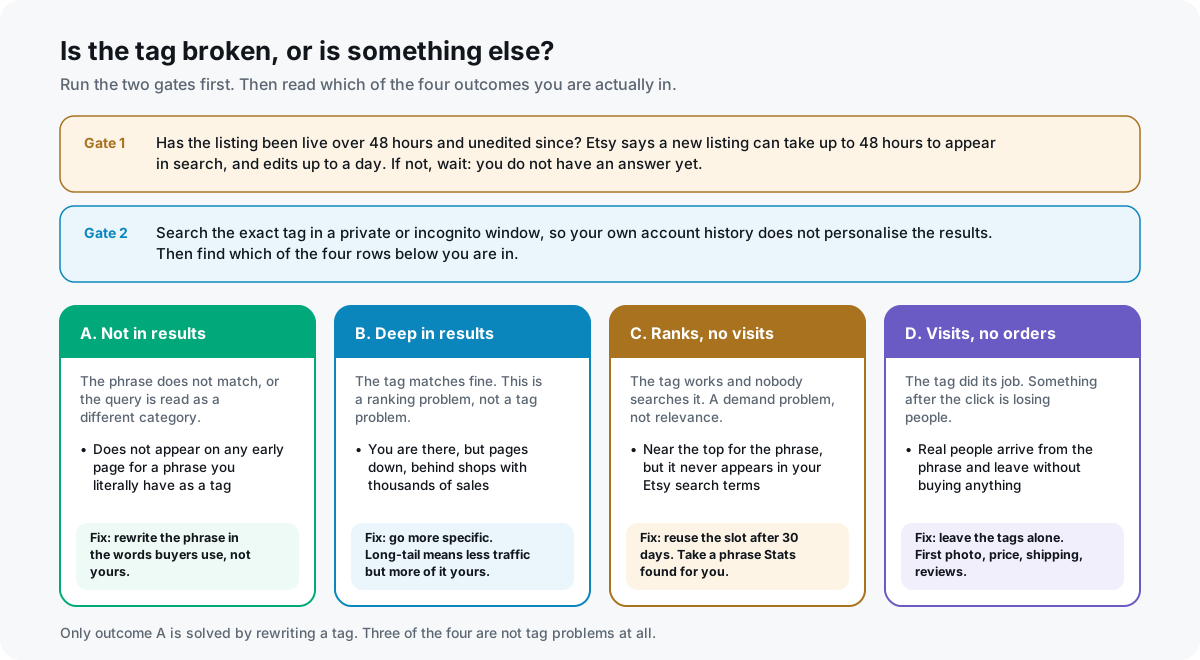
This is the least glamorous part of the process and it disqualifies a surprising number of panics. Etsy's own help page on creating a listing states that once published, it may take up to 48 hours for your listing to appear in Etsy search results and categories. Separately, Etsy states that changes to a listing can take up to one day to reflect in search.
So if you published yesterday, or edited your tags this morning, you do not have a tag problem yet. You have a listing that has not finished being indexed. Checking a tag inside that window and concluding it does not work is the single most common self-inflicted wound in this whole topic, because it leads people to rewrite tags that were never given a chance, which resets the clock again.
There is a second timing trap that is subtler. Etsy documents a small, temporary boost for newly created listings, described in its own words as lasting anywhere from a few hours to a few days, and its stated purpose is to gather data on how buyers interact with the listing rather than to reward you. That means the first few days of traffic on any new listing are not representative. They are Etsy sampling. If you judge a tag on day two you may be reading the boost, and if you judge it on day five you may be reading the drop off the boost. Neither is the tag's real performance.
Check one: search for your own tag, exactly as you wrote it
This costs nothing, needs no data, and works on a shop that opened last Tuesday. It answers the eligibility question directly.
Open a private or incognito window so your own browsing history does not personalise the results. Etsy explicitly lists shoppers' habits as a ranking input, using what it calls Context Specific Ranking to learn what individual buyers are interested in, so searching while logged into your own account is genuinely misleading. Type one of your tags into Etsy's search bar, exactly as you wrote it, and look.
- Filter down to your own shop if you need to find yourself quickly, then remove the filter and count how far down you actually sit in the unfiltered results. Page depth is the number that matters, not the fact that you exist somewhere.
- If your listing appears at all, on any page, the tag is matching. Eligibility is confirmed. Your problem, if you have one, is rank.
- If your listing does not appear anywhere in the first several pages for a phrase you literally have as a tag, and the listing has been live longer than 48 hours, something else is going on: the phrase may be far more competitive than you assumed, or Etsy may be reading the query as belonging to a different category than yours.
- Look at who is above you. Not to copy them. To calibrate. If the entire first page is shops with four thousand sales and hundreds of reviews, your tag is not broken, it is simply pointed at a fight you cannot win yet.
Repeat this for the three or four tags you consider your best, not all thirteen. If your strongest phrases put you on page nine behind established shops, you have learned the most useful thing available to a new seller: your tags are fine and your targeting is too ambitious. That is a completely different fix from rewriting tags.
This is also, quietly, the answer to "how do I check my tags when I have no Stats yet". You search for them. It is not sophisticated and it is not automatable, and it is the only method available before you have traffic, which is exactly when most people are asking the question.
Check two: read the numbers in Etsy Stats
Once you have traffic, Etsy tells you which phrases brought it. In Shop Manager, open Stats, and under "How shoppers found you" choose Etsy search. That view lists the actual search terms people used to find your listings. This is the closest thing to a direct answer that exists, and it is free, and a startling number of sellers have never opened it.
Two things about that data that are worth knowing before you read too much into it. Etsy states that listing views are updated in real time, but that visits data refreshes a few times per day, and that Etsy filters out bot traffic again at the end of the day, which may lower your visit count. So a visit number you screenshot at lunchtime can legitimately be lower by midnight. That is not a glitch and it is not Etsy hiding your traffic, it is bot filtering catching up.
You are looking for four things, in this order.
- Which of your thirteen tags appear in that list at all. Every phrase that never appears has produced nothing measurable. That is your dead-tag list.
- Which phrases appear that you never wrote. These are gifts. Etsy matched you to a query through your title, categories, attributes or description, and a real human typed it. A phrase in this list is proven demand, and it is a far better candidate for a tag slot than anything you can guess.
- Whether traffic is concentrated. It very often is. Two or three phrases carrying nearly all the search traffic to a listing is normal, not a failure. It does mean the other ten slots are doing nothing and are free to be re-aimed.
- Whether the phrase that brings visits also brings orders. Etsy shows visits, orders, conversion rate and revenue at shop level. A term that brings visits and never converts is a mismatch: people searching it want something adjacent to what you sell.
Etsy also runs a Search visibility page in Shop Manager, which surfaces suggested actions across your listings, your shop and your customer service. It is worth reading, but understand what it is: a recommendation panel, not a metrics dashboard. Etsy notes that once improvements are made, insights typically disappear within 24 hours. It will not tell you which of your tags is dead.
What counts as a dead tag, in actual numbers
Nobody writing about this commits to a number, so here is one, with its reasoning attached so you can disagree with it intelligently.
Give a tag one full month of the listing being live and unedited. Not a week. A month. If, after thirty days, that exact phrase has never once appeared in your Etsy search terms, treat it as dead and reuse the slot. Not because thirty days is a magic number, but because it is comfortably longer than the 48-hour indexing window, longer than the few-days recency boost, and long enough that a phrase with any real search volume would have surfaced at least once.
The important discipline is the unedited part. Every time you edit a listing you restart the measurement, and you also re-trigger the recency effect, which makes the following few days unrepresentative again. Sellers who rewrite tags every four days because nothing is happening never accumulate a single clean thirty-day window, and so they never actually learn anything. They just keep sampling noise.
One nuance worth holding onto: a dead tag is not always a bad phrase. It can be a phrase with genuine demand that you simply cannot rank for yet. The practical response is the same either way, which is to reuse the slot on something more specific, but the emotional response should be different. You did not necessarily write a stupid tag.
Six tag rules that most advice gets backwards
This is the part where checking your tags turns into fixing them. Each of these is documented by Etsy itself, and each is contradicted by a large amount of popular advice.
One. Do not stack the same phrase across several tags. Etsy's own keyword guidance says the thirteen tags you add should all be as unique as possible, and Etsy staff have described the goal as variety. The widespread advice to repeat a core phrase across multiple slots to reinforce it has no Etsy source behind it and costs you slots that could be covering different queries.
Two. Do not spend a slot on the plural. Etsy states that it looks at the root words of a query and matches them to the root words in your listings' keywords, giving the example that a search for "diaries" will still match a listing tagged "diary". Singular and plural do not need separate tags. Neither, generally, do regional spellings: Etsy says a shopper searching "jewellery" will still be shown listings tagged that way, though it also notes it does not account for every regional phrase.
Three. Do not repeat what your categories and attributes already say. Etsy's wording is direct: the categories and attributes you add act like tags, so if an exact phrase appears in your categories, you do not need to add it as a tag. Note that Etsy says you do not need to, not that you will be penalised. But if you have filled in your attributes properly and then spent tag slots restating them, you have quietly given away slots for nothing.
Four. Word order matters for ranking, not for eligibility. Etsy staff have explained that if your tag is "shirt dress" and someone searches "shirt dress", you may rank higher than a listing with the words the other way round, but the listing remains eligible for both searches. So write the order a real person would type, and do not waste two slots covering both directions.
Five. Multi-word phrases beat single words. Etsy says this outright, with its own example that "custom bracelet" is stronger than "custom" and "bracelet" as separate tags, and separately advises prioritising less popular phrases that describe what is really special about your product rather than competing for generic searches like "tote bag". You have twenty characters per tag and thirteen tags. Single words waste both.
Six, and this one is recent enough that most guides have not caught up. In April 2026 Etsy published new guidance on listing titles telling sellers to state the item plainly, lead with the essential descriptors, consider using fewer than fifteen words, avoid repetition, avoid subjective words like perfect or beautiful, and move supplementary detail into tags, description and attributes. That is close to the opposite of the still-dominant advice to fill all 140 characters with comma-separated keyword phrases. If your title reads like a keyword list, it is now working against Etsy's own published guidance.
Looking at competitor tags without copying them
You can see another seller's tags. Etsy exposes them in the page source of a listing, and several browser extensions and keyword tools surface them for you. There is no rule against looking.
The trap is that seeing them tells you almost nothing on its own, because you cannot see which of those thirteen tags is actually producing the traffic. You are looking at a list where roughly three phrases are doing the work and ten are dead weight, and you have no way to tell which is which. Copying all thirteen imports their dead weight into your listing.
What competitor tags are genuinely good for is vocabulary. If four unrelated shops in your niche all describe the item with a word you have never used, that word is what buyers call the thing, and you are probably describing your own product in your own language rather than theirs. Take the vocabulary, not the list. Then check the phrase yourself with the incognito search above, because a phrase that works for a shop with two thousand reviews may put you on page eleven.
Pick your comparison shops carefully too. The right competitor to study is not the biggest shop in the category. It is a shop roughly your size, selling roughly your thing, that is clearly outperforming you. A shop with four thousand sales ranks for phrases you cannot reach on strength you do not have, and its tags will teach you the wrong lesson.
When it is not the tags at all
Etsy publishes what it weighs in search, and tags are one input among several. The current list on Etsy's own How Etsy Search Works page covers relevancy, shop quality, listing quality, customer service quality, translations and language, listing engagement rate, recency and shoppers' habits. Two of those deserve a mention here, because they explain a lot of otherwise baffling results.
Listing engagement rate is how well a listing converts: how many people view it and then buy. Etsy uses that to decide whether buyers are actually interested. This creates a feedback loop that punishes weak listings independently of their keywords. If your photo does not earn the click, or your price sits oddly against the page you appear on, your engagement rate stays low and your ranking follows it down, no matter how well chosen your tags were. In that situation rewriting tags is like retuning a radio that is not plugged in.
Shipping price is the other one, and it is commonly out of date in seller advice. Since October 2024 Etsy prioritises listings with US domestic shipping prices under six dollars in search, on the stated reasoning that once shipping reaches six dollars buyers become less likely to purchase. A lot of circulating advice still points at the older free shipping guarantee on orders over thirty five dollars as the lever. If your shipping sits above that six dollar line, you are carrying a ranking handicap your tags cannot compensate for.
The clean test is the one from the diagram. If a phrase brings you visits and no orders, stop editing tags. The tag did its job, it delivered a human being to your listing, and the listing did not close. That is a photo, price, description or trust problem.
A twenty minute check you can run once a month
Put this on a monthly repeat rather than doing it in a panic at 1am, which is when most tag rewrites happen and why so many of them are bad.
- Open Stats, set the range to the last 30 days, and open How shoppers found you, then Etsy search.
- Write down every search term listed. Mark each one as a tag you wrote, or a phrase Etsy found for you.
- List the tags on that listing that never appeared. Those slots are available.
- Take the two strongest phrases Etsy found for you that you had not written, and give them slots. Real queries beat guesses every time.
- Search your two best tags in an incognito window and note your page depth. Compare it to last month's note. This is the only way to see movement that is not visible in traffic numbers yet.
- Change tags on one listing at a time, not across the shop, and then leave it alone for thirty days. If you change everything at once you will never know which change did what.
That last point is the entire discipline in one sentence. Tags are testable, but only if you let a test finish.
Want the listing scored for you first? F5 Listing Check is a free Chrome extension that rates any open Etsy listing out of 100 on tags, SEO signals, photo count, description clarity and how it reads on mobile, and keeps your last five scores so you can see whether a fix actually moved anything. →Frequently asked questions
How many tags does an Etsy listing get, and how long can each one be?
Thirteen tags per listing, up to 20 characters each. Tags may include spaces, letters and numbers. Titles are separate and can run to 140 characters, though as of April 2026 Etsy's own guidance suggests keeping them to fewer than fifteen words rather than filling the limit.
How long does it take for new tags to start working?
Etsy says a newly published listing can take up to 48 hours to appear in search results and categories, and that edits to an existing listing can take up to a day to reflect in search. Beyond that, give a tag around thirty days of the listing being live and unedited before you judge it, because the first few days are distorted by the temporary recency boost Etsy gives new and renewed listings.
Should I use both the singular and plural version of a keyword?
No. Etsy matches on root words, and its own example is that a search for diaries will still match a listing tagged diary. Spending two of your thirteen slots on singular and plural is spending one slot for nothing.
Is it worth repeating my main keyword across several tags?
Etsy's published guidance says the thirteen tags should all be as unique as possible. The advice to stack or layer a phrase across several slots has no Etsy source behind it, and it costs you coverage of other queries.
Where do I actually see which search terms brought me traffic?
Shop Manager, then Stats, then under How shoppers found you choose Etsy search. That view lists the real search terms shoppers used. Note that listing views update in real time while visits refresh a few times a day and are filtered for bot traffic at the end of the day, so a visit count can legitimately drop slightly later in the day.
My tags bring views but no sales. Do I need new tags?
Almost certainly not. A tag that brings a real person to your listing has done its job. Views without orders is a conversion problem, which usually means the first photo, the price relative to what else appeared in that search, the description, or a shortage of reviews. Etsy also says it watches listing engagement rate, meaning how many people view a listing and then buy, so a low conversion rate can gradually pull your ranking down as well.
Can I see my competitors' tags, and should I copy them?
You can see them, and it is not against any rule. Copying them wholesale is a bad idea, because roughly three of any shop's thirteen tags do the real work and you cannot tell from outside which three. Take the vocabulary rather than the list, and pick competitors roughly your own size rather than the biggest shop in the category.
Does renewing a listing improve my tags' performance?
Renewing re-triggers the recency effect, which Etsy describes as a small, temporary boost lasting anywhere from a few hours to a few days, given so its search system can learn how buyers interact with the listing. Etsy has never presented repeated renewal as a ranking strategy, and it costs 20 cents each time. It also resets any clean measurement window you had going.
Do I need a paid keyword tool to check whether my tags work?
No. The two checks that matter most, searching your own tag in an incognito window and reading your Etsy search terms in Stats, are both free and come from Etsy itself. Paid tools are useful mainly for discovering new phrases and estimating competition, not for telling you whether a tag you already have is working.
How do I judge my tags if my shop is brand new and Stats is empty?
Use the search check rather than the data check. Search each of your best tags in an incognito window and record how many pages deep your listing sits. That tells you whether the tag matches at all and how hard the phrase is, neither of which requires any traffic history. Repeat monthly and watch the page depth move.
The short version
A tag is not working when it never appears in your Etsy search terms after thirty days of the listing being live and unedited. A tag that appears but brings no orders is working, and something else in the listing is not. A tag you cannot rank for is not a bad tag, it is an ambitious one, and the fix is a more specific phrase rather than a better guess at the same broad one.
The reason so few sellers ever find out which of their tags work is not that the data is hidden. It is that changing tags feels like doing something and waiting does not. Waiting is the part that produces the answer.