


The question sellers ask is is this word trademarked. It feels like a yes or no question with a lookup that settles it. It is not, and treating it as one produces both of the expensive mistakes: dropping a term that was never a problem, and confidently using one that is.
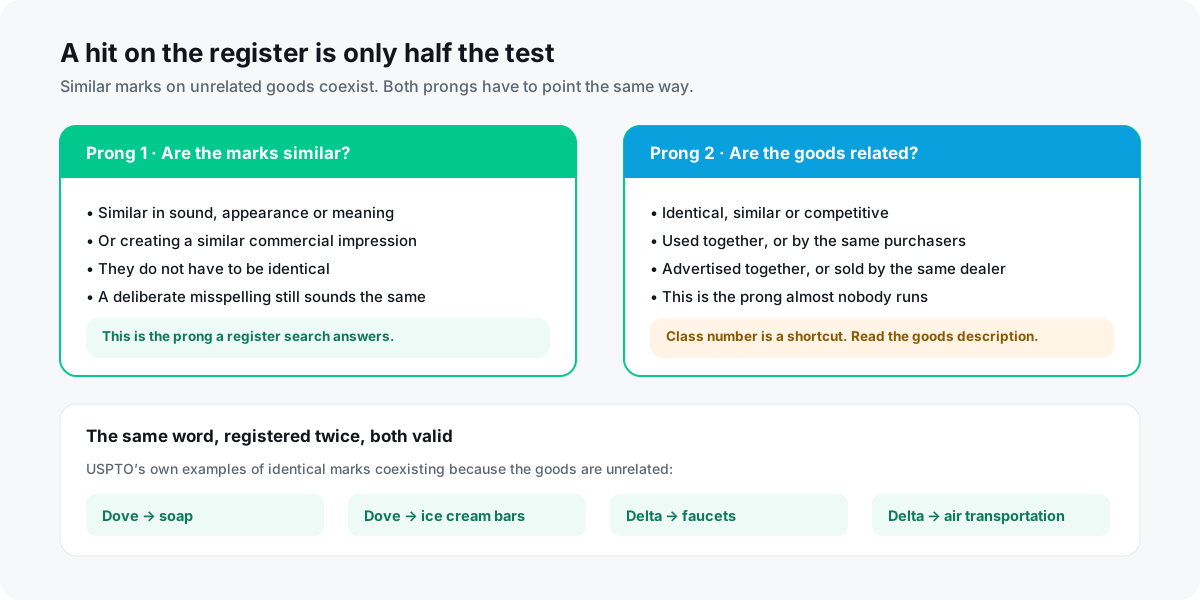
Here is the fact that reframes it. Dove is a registered trademark for soap and Dove is a registered trademark for ice cream bars, owned by different companies, both perfectly valid. Delta is registered for faucets and Delta is registered for air transportation. That is not a loophole, it is the USPTO's own illustration of how the system works. A word is not trademarked in general. It is registered by someone, for particular goods and services.
Which means the useful question is not whether your phrase appears on the register. It is whether it appears on the register, held live by someone, for goods related to what you sell. Nothing here is legal advice, and a genuinely close call is worth an attorney rather than a blog post.
The two part test, and the half everyone skips
The USPTO evaluates conflicts using likelihood of confusion, and it has two prongs. Both have to point the same way before there is a problem.
- Are the marks similar? They do not have to be identical. The USPTO looks at whether marks are confusingly similar in sound, appearance, or meaning, or could create a similar commercial impression. A deliberate misspelling does not solve anything, because it still sounds the same.
- Are the goods or services related? This is the prong sellers never run. The USPTO weighs whether goods are identical, similar or competitive, used together, used by the same purchasers, advertised together, or sold by the same manufacturer or dealer.
Similar marks on unrelated goods can coexist, which is how Dove and Delta each exist twice. Similar marks on related goods conflict, even where the words are not identical. So a search that only answers prong one gives you an answer with the deciding half missing.
What a class is, and why yours is usually 25 or 16
Registrations are filed against numbered classes of goods and services. There are 45 of them, and the number in the record tells you the territory the owner actually claimed.
Most Etsy sellers live in a handful. Class 25 is clothing, footwear and headgear, which is where t-shirt and apparel sellers collide with almost everything. Class 16 is paper goods and printed matter, which covers a great deal of printables, stationery and planners. Class 21 covers housewares including mugs and drinkware. Class 14 is jewellery. Class 20 covers furniture and some wooden goods. Class 41 is education and entertainment services, which is where courses and some digital content sit.
The practical consequence is that the same phrase can be entirely safe on a mug and a live problem on a shirt, because someone registered it in 25 and nobody registered it in 21. A seller who checks the phrase and sees a registration, without looking at what it was registered for, throws away a perfectly good product name. A seller who expands into apparel a year later, using a name that was fine on paper goods, walks into the one class where it was taken.
Live, dead, and the records that do not bind anyone
A search result is not automatically a live right, and this is the second place people misread the register.
- Live means the registration is in force, or the application is pending. These are the ones that matter.
- Dead means abandoned, cancelled or expired. Registrations lapse constantly, because owners have to file maintenance documents and many do not. A dead record is a historical artefact.
- Pending means someone applied and it has not been examined or granted. It is a signal of intent, not yet a right, and it can still be refused.
- Supplemental register entries are weaker than principal register entries, because the mark was not considered distinctive enough at filing.
There is also a category that never appears in a search at all, and it is the one that produces the nastiest surprises: unregistered rights. In the United States, rights arise from use in commerce rather than from registration, so a business that has been selling under a name for years can hold enforceable common law rights without a single record. Etsy acts on reports rather than on registration certificates, so an unregistered claimant with a plausible complaint can take your listing down as effectively as a registered one.
How to actually run the search
For the United States, the USPTO's trademark search system at tmsearch.uspto.gov is free and authoritative. For the EU and much of the rest of the world, TMview aggregates national and regional registers into one search. Between them you cover most of what will realistically be enforced against a shop selling internationally.
The sequence that gives a usable answer, per term:
- Search the exact phrase, then search it with plausible variants: singular and plural, hyphenated and not, and any spelling that sounds the same when read aloud.
- Filter to live records. Read past the dead ones rather than counting them.
- For each live hit, open the record and read the goods and services description, not just the class number. The description is what the owner actually claimed and it is often narrower than the class implies.
- Ask prong two honestly. Are those goods related to yours in the way the USPTO describes: competitive, used together, bought by the same people, sold through the same channels?
- Note the owner. A registration held by a company with a brand protection operation behaves very differently in practice to one held by a dormant sole trader, even where the paperwork looks identical.
- Write down what you checked and when. In six months you will not remember, and a dated note is what stops you re-litigating the same term every time you write a listing.
That is roughly four to eight minutes per term done properly. It is fine for a new product name. Across an existing shop with forty listings and thirteen tags each, it is several hundred terms, which is where the honest advice stops being do it yourself.
The words that actually get shops reported
The intuition that catches people out is that risky words look risky. They do not. Nobody accidentally puts a famous studio's character in a title. The reports that land come from three quieter places.
- Ordinary phrases somebody registered. Short, natural two and three word phrases that sound like plain English are registered constantly, particularly in class 25. The phrase reads as generic, so nobody checks it, and the owner enforces it precisely because it reads as generic and turns up everywhere.
- Descriptive terms that became brand names. Words that used to describe a category and are now somebody's mark. Sellers use them as descriptions in perfect good faith.
- Event, team, institution and character names used as tags. Not in the product, just in tag eleven, put there for search traffic and then forgotten for two years.
All three share a shape: the term is doing very little for you and carrying all of the risk. That asymmetry is what makes a shop sweep worth doing, because the fix in nearly every case is deleting a tag that was not earning anything.
Where the register is not the answer at all
Two situations look like trademark questions and are not.
The first is artwork. If you have reproduced somebody's illustration, character or photograph, no amount of searching the trademark register helps, because that is copyright and it works differently. It is also the one kind of IP report on Etsy that has a counter notice route, which is covered in why the counter notice everyone recommends does not exist for trademark.
The second is a listing that was removed for a reason unrelated to IP entirely. Creativity Standards, prohibited items and misrepresentation removals arrive by a similar looking email and have a genuine appeal route inside Etsy, which the trademark ones do not. Working out which you are holding before you act on it is covered in the guide to appealing a removed Etsy listing.
A workable rule for a working shop
You cannot run a full clearance analysis on every word you type, and pretending otherwise leads to people running none. A proportionate rule:
- Search properly before you commit to a product name, a shop name or anything you will build a line on. That is worth its ten minutes.
- Never put a brand, team, event, character or institution name in a tag for traffic. This is the single highest ratio of risk to benefit on the whole platform.
- Sweep the whole shop once, then again after any bulk listing push or category expansion. The class you moved into is the one where your safe name may not be.
- Keep a dated note of what you cleared, so the work is cumulative rather than repeated.
The sweep is the part that does not fit into a working week, because it is hundreds of terms, each needing the live check, the goods and services read and the owner look-up before it can be called clear. That is the whole job of the Etsy trademark check: every title, tag and description screened against the marks that are actually enforced on Etsy, anything unfamiliar verified live against USPTO and TMview, each flagged listing returned with who owns the mark and in which class, and a replacement title and 13 tag set already written so you are pasting rather than re-researching. The terms that came back clear are listed too, which is what lets you stop wondering about the rest.
Have the whole shop screened →How do I check if a word is trademarked?
Search the USPTO's trademark search system at tmsearch.uspto.gov for the United States and TMview for the EU and other registers. Search the exact phrase plus plausible variants, filter to live records, then open each hit and read the goods and services description rather than stopping at the class number. A hit only matters if the mark is live and covers goods related to what you sell.
Can two companies have the same trademark?
Yes, when the goods or services are unrelated. The USPTO's own examples are Dove soap and Dove ice cream bars, and Delta faucets and Delta air transportation services, each owned by different companies and each validly registered. This is why finding your phrase on the register does not by itself mean you cannot use it, and why the class and the goods description matter more than the hit.
What trademark class do Etsy sellers need to check?
It depends on the product. Class 25 covers clothing, footwear and headgear and is where apparel sellers face the most conflicts. Class 16 is paper goods and printed matter, covering many printables, planners and stationery. Class 21 covers housewares including mugs. Class 14 is jewellery, class 20 is furniture and some wooden goods, and class 41 is education and entertainment services. The same phrase can be free in one and taken in another.
Is a word safe to use if the trademark shows as dead?
A dead record means the registration was abandoned, cancelled or expired, so that particular right is not in force. It is a better position than a live hit, but it is not a clearance. In the United States rights come from use in commerce rather than registration, so a business still trading under the name may hold enforceable common law rights that never appear in a search, and Etsy acts on reports rather than on certificates.
Can I use a trademarked word in my Etsy tags?
Putting brand, team, event, character or institution names in tags is the highest risk to lowest benefit move available on Etsy. Tags are not visible the way titles are, so they get forgotten, and they are exactly what automated brand protection sweeps search. The term is usually contributing very little traffic while carrying the entire reporting risk, which is why tag clean-up is normally the cheapest fix a shop can make.
Does misspelling a brand name make it safe to use?
No. The USPTO's test asks whether marks are confusingly similar in sound, appearance or meaning, or create a similar commercial impression. A deliberate misspelling generally sounds identical when read aloud, which is precisely what the test captures. It also tends to make intent look worse rather than better if the matter is ever examined.
Do I need to check trademarks outside the United States?
If you ship internationally, yes. Rights are territorial, so a phrase clear in the United States can be registered and enforced in the EU or the UK by an entirely different owner. TMview searches across many national and regional registers at once and is the practical starting point alongside the USPTO for a shop selling across borders.
Everything above reflects the position as published by the USPTO and Etsy as of August 2026, and describes how the systems generally work rather than how any particular dispute will come out. A genuinely close call, or anything with a letter from an attorney attached, is worth paying a lawyer for rather than resolving from a search result.