


The most upvoted version of this question on Reddit is titled something close to: I have been trying to sell on Etsy for a month with no sales and I am starting to think my work is not good enough. It has over a hundred replies. That framing, where a quiet month becomes evidence about your talent, is the actual problem this article is trying to solve, and it is worth saying plainly at the top: a month with no sales tells you almost nothing about your product. It usually tells you about your sample size.
Here is the arithmetic that nobody puts in front of new sellers, and it defuses most of the panic on its own.
Etsy publishes a conversion benchmark. In its own guidance, Etsy says sellers should generally expect a conversion rate between one and five percent, while noting it varies significantly across categories and price points and is best measured over longer periods. Take the middle of that range. At around two percent, one sale takes roughly fifty visits. So a shop with forty visits and zero sales is not underperforming. Its statistically expected number of sales was under one. Zero was the most likely outcome.
That does not mean nothing is ever wrong. It means you cannot tell yet, and the correct next move is to find out which of two completely different problems you have before you start fixing things at random.
The only question that matters first: do you have views?
Every article on this subject gives you a flat list of ten or twelve reasons, and every one of them is a real reason, and none of them tell you which one is yours. But there is a fork at the top that splits the whole problem in half, and it takes ten seconds to answer.
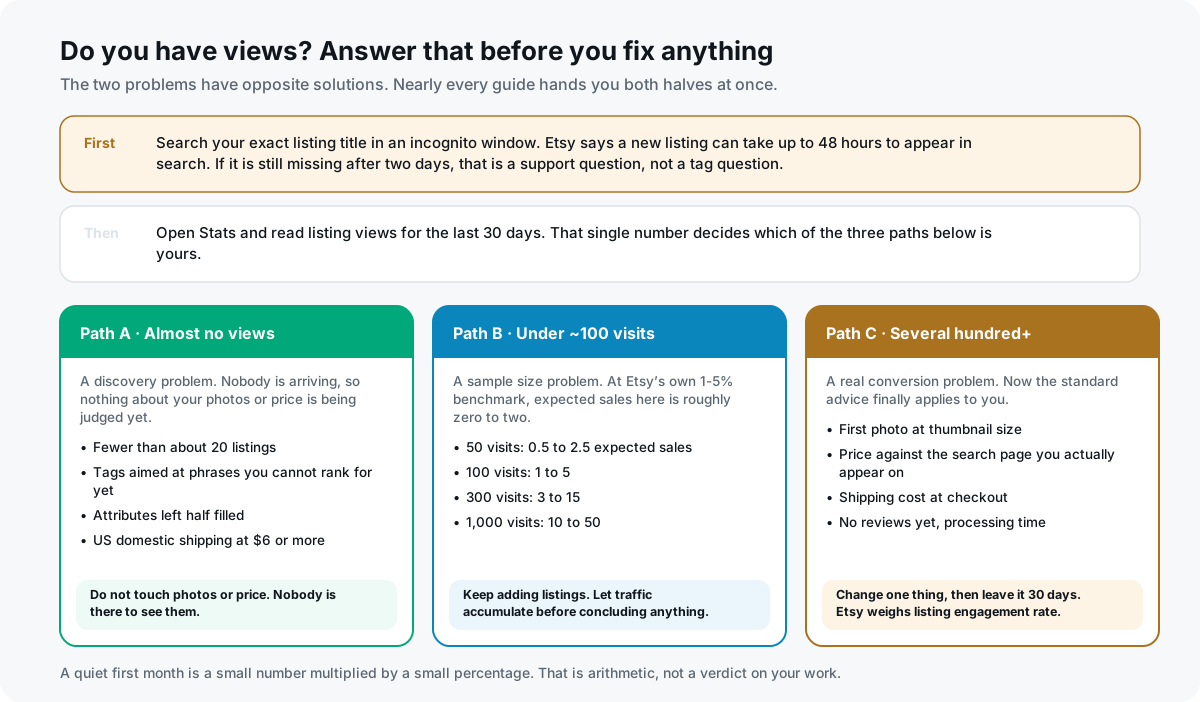
Open Stats in Shop Manager and look at your listing views for the last thirty days.
- Almost no views at all. This is a discovery problem. Nobody is seeing your listing, so nothing about your photos, price or description is being judged yet. Everything in the conversion half of the standard advice is irrelevant to you today.
- Views but no orders, and fewer than about a hundred visits. This is a sample size problem. At one to five percent conversion, you have not yet run a large enough test to have earned a result. The honest fix is more traffic, not more tinkering.
- Views but no orders, and several hundred visits or more. Now you have a genuine conversion problem, and now the photo, price, shipping and description advice actually applies to you.
Almost everyone reading this is in one of the first two groups and treating themselves as though they were in the third. That is why the standard advice does not help: it is written for the third group, and it is handed to everyone.
Before anything: is the listing even indexed?
Etsy's own help documentation states that once published, a listing may take up to 48 hours to appear in Etsy search results and categories, and that edits to a listing can take up to a day to reflect in search.
So the first check is mechanical. Open a private or incognito window, so your own account history does not personalise the results, and search for your exact listing title. If your listing comes up, it is indexed and findable, and you can stop worrying about that. If it does not, and the listing has been live for more than two days, search for a long and unusually specific phrase from your title. If it still does not appear, the issue is worth raising with Etsy support rather than solving by rewriting tags.
There is no documented new shop probation period, sandbox, or minimum number of sales before Etsy will show your listings. That belief circulates widely and Etsy has never published anything supporting it. The only official timing statements are the 48 hour indexing window, the roughly one day for edits to reflect, and a small temporary recency boost for new and relisted items that Etsy describes as lasting from a few hours to a few days.
Path A: almost no views. This is a discovery problem.
If nobody is arriving, nothing downstream matters yet. There are four causes worth checking, roughly in order of how often they turn out to be the answer.
One: you do not have enough listings. This is the most common and the least glamorous. Each listing is a separate entry point into Etsy search with its own thirteen tags, its own title and its own categories and attributes. Five listings is roughly sixty-five tag slots. Thirty listings is nearly four hundred. You are not six times more likely to be found, because your listings overlap, but you are far more likely to be found for something. Etsy's own new seller guidance frames it in terms of trust as well: a well stocked shop shows shoppers your business is legitimate.
Two: your tags are aimed at fights you cannot win. Search your best tag in an incognito window and count how many pages down you sit. If the first page is entirely shops with thousands of sales, your tag is not wrong, it is ambitious. Etsy's own keyword guidance says to prioritise less popular phrases that describe what is really special about your product rather than competing for generic searches like tote bag. More specific phrases have less traffic and a far greater share of it available to you.
Three: your attributes and categories are half filled. Etsy states directly that categories and attributes act like tags. An empty attribute panel is unused keyword space, and it is free.
Four: your shipping price is above the line. Since October 2024 Etsy prioritises listings with US domestic shipping prices under six dollars in search, on the stated basis that at six dollars and above buyers become less likely to purchase. A lot of older advice still points to the free shipping guarantee on orders over thirty five dollars, which was superseded. If your shipping sits above six dollars, you are carrying a ranking handicap.
What is not the answer at this stage: rewriting your description, redoing your photos, or dropping your price. Those are conversion levers, and nobody is arriving to be converted.
Path B: some views, small numbers. This is a sample size problem.
This is the group that suffers most, because they have just enough data to torture themselves with and not enough to learn anything from.
Run the numbers on your own shop. Take your visits for the last thirty days and multiply by one percent and by five percent. That gives you the range of sales Etsy's own published benchmark would predict for a shop like yours.
- 50 visits: between 0.5 and 2.5 expected sales. Zero is entirely ordinary.
- 100 visits: between 1 and 5. Zero is on the low side but well within normal variation.
- 300 visits: between 3 and 15. Zero here is starting to be a real signal.
- 1,000 visits: between 10 and 50. Zero at this point is a genuine conversion problem and needs the Path C checklist.
Note what those numbers do to the standard advice. Telling a shop with sixty visits to improve its photos is not wrong exactly, but it is unfalsifiable: whatever they change, the next sixty visits will probably also produce zero sales, and they will conclude the change failed and change something else. That loop is how new sellers end up rewriting their entire shop every fortnight and learning nothing.
The right move in Path B is to keep adding listings and keep the traffic accumulating until the numbers can actually answer a question. It feels like doing nothing. It is not. It is refusing to draw conclusions from noise, which is a skill most sellers acquire only after wasting a year.
Path C: real traffic, no orders. Now it is conversion.
If you have several hundred visits or more and nothing has sold, something in the listing is genuinely losing people. In rough order of impact:
- The first photo. It is not competing on your listing page, it is competing in a grid of thirty thumbnails, most of which are professionally shot. If it does not survive being three centimetres wide on a phone, nothing else in the listing ever gets read.
- Price against the page you appear on. Not against your costs, and not against what you feel it is worth. Search your own main keyword and look at the row your listing sits in. If you are the most expensive thing on the page with the fewest reviews, buyers have no reason to take the risk.
- Shipping cost at checkout. A shipping charge that appears late reads as a penalty rather than a price. It is also, separately, a search ranking factor under six dollars for US domestic.
- No reviews yet. This is real and it is temporary. On a shop with nothing else to go on, buyers use reviews as a proxy for whether you will actually ship. A complete About section with photos and thorough shop policies partially substitute for it, which is why they are worth doing properly in week one.
- Processing and delivery times. A long or vague dispatch window loses gift buyers instantly, and gift buying is a large share of Etsy.
- The description's first three lines. Almost nobody reads past them on mobile, and almost everybody writes them as though they will.
There is a second reason conversion matters beyond the sale itself. Etsy lists listing engagement rate among its ranking factors, describing it as looking at how well a listing converts, meaning how many people view it and then make a purchase, to determine whether buyers are interested. A listing that gets traffic and never converts can gradually lose ranking. Which means a conversion problem left alone eventually becomes a traffic problem, and then the shop looks like it is dying when the original issue was one photograph.
The forum thread trap
At some point in a bad week you will search this problem and land in Etsy's community forums or a Reddit thread with several hundred replies, titled something like traffic down 56 percent or zero views in eight months. It will read like confirmation that the platform is broken and there is no point continuing.
Read who is writing. Those threads are overwhelmingly established sellers describing a decline from a high base, and a decline is a completely different phenomenon from a beginning. A shop that went from four hundred visits a day to ninety has a real and serious problem. A shop that has had ninety visits total is not experiencing the same thing, and the advice in those threads, which is usually about diagnosing what changed, does not apply to a shop where nothing has changed because nothing has happened yet.
Etsy's own help page on this subject has the same mismatch. It is titled around what to do if you notice a drop in sales, which is genuinely useful if you had sales to drop. It is written for a different reader than the one asking this question.
How long is too long?
There is no honest universal number, and anyone giving you one is selling a course. What is worth knowing is that Etsy's own published seller story about opening a shop features a seller who made her first sale a year after opening, after finally investing time in her descriptions, tags and titles. Etsy presents that as one person's experience rather than a benchmark, but it is Etsy's own example, and it is a useful corrective to the content promising a first sale in thirty days.
A more useful framing than time is volume. Judge yourself on visits accumulated and listings published, not on weeks elapsed. Two months with five listings and sixty visits is not two months of evidence. It is sixty visits of evidence, which is almost none. Two months with forty listings and eight hundred visits is a real test, and a real test deserves a real response.
If you want a single point at which to take a hard look, use a thousand visits. Below that, keep building. Above that with no orders, go through Path C properly and change one thing at a time.
What to actually do this week
- Open Stats and write down two numbers: visits in the last thirty days, and orders. Multiply visits by 0.01 and by 0.05. That range is your realistic expectation. Compare honestly.
- Search your exact listing title in an incognito window and confirm you are indexed.
- Count your live listings. If it is under twenty, that is your project for the month, ahead of everything else on this page.
- Fill in every attribute and pick the most specific category for every listing. It is free keyword space and it takes an evening.
- Check your US domestic shipping price against the six dollar line.
- Then stop changing things for thirty days and let the data accumulate. This is the hardest item on the list and the one that produces the answer.
Frequently asked questions
Is it normal to have no sales in the first month on Etsy?
Yes, and the arithmetic explains why. Etsy's own guidance puts typical conversion at one to five percent, so at around two percent a sale takes roughly fifty visits. A new shop with a handful of listings often does not accumulate fifty visits in its first month, which makes zero sales the statistically expected outcome rather than a sign that something is wrong.
Why does my new Etsy shop have no views at all?
Check indexing first: Etsy says a new listing can take up to 48 hours to appear in search and categories. After that, the usual causes in order are too few listings, tags aimed at phrases far too competitive for a new shop, half-filled attributes and categories, which Etsy says act like tags, and US domestic shipping priced at six dollars or more, which Etsy deprioritises in search.
Is there a probation period for new Etsy shops?
There is no documented probation, sandbox or minimum sales requirement before Etsy will show your listings. The belief is widespread and Etsy has never published anything supporting it. The only official timing statements are the 48 hour indexing window, roughly a day for edits to reflect in search, and a small temporary recency boost for new and relisted items lasting hours to days.
How many views should a new Etsy shop expect?
Etsy does not publish a figure and it varies enormously by category, so treat any specific number you see as invented. The more useful measure is visits per listing over time, and the more useful goal is accumulating enough visits to draw a conclusion at all, which given a one to five percent conversion rate means several hundred rather than several dozen.
I have views but no sales. What does that mean?
It depends entirely on how many. Under about a hundred visits it means nothing yet, because the expected number of sales at Etsy's own benchmark rate is around one or two. Above several hundred visits with no orders it is a genuine conversion problem, and the usual causes are the first photo, the price relative to competing listings on the same search page, shipping cost, and having no reviews yet.
Should I lower my prices if nothing is selling?
Not as a first move, and not on low traffic. If nobody is arriving, price is not what is stopping them. If people are arriving, compare your price against the actual listings that appear alongside yours in a search rather than against your costs, and remember that on a shop with no reviews a low price can read as suspicious rather than attractive.
Do I need to keep adding listings if the ones I have are not selling?
For a young shop, yes, and it is usually the highest impact thing available. Each listing is an independent entry point with its own thirteen tags, and Etsy also gives newly created listings a small temporary boost so its search system can learn how buyers interact with them. Adding listings steadily gives you both more coverage and repeated legitimate reasons to be sampled by Etsy search.
Why does the Etsy forum say everyone's traffic has collapsed?
Because those threads are mostly written by established sellers describing a decline from a high base, which is a different problem from a new shop that has not started yet. A shop dropping from four hundred visits a day to ninety has something to diagnose. A shop that has had ninety visits in total does not have a decline, and the advice in those threads is not aimed at it.
How long should I give a change before deciding it did not work?
Around thirty days on a listing you leave otherwise alone. Etsy says edits can take up to a day to reflect in search, and editing also re-triggers the temporary recency effect, so the days immediately after a change are not representative. Changing several things at once, or changing something every few days, guarantees you will never know which change did what.
At what point should I accept the product itself is the problem?
Not before you have real traffic. A useful threshold is a thousand accumulated visits: below that you do not have enough evidence to judge anything, and above that with no orders you have a genuine conversion problem worth working through methodically. Even then, a conversion problem is far more often the first photo or the price against the page than the product.
The short version
Check whether you have views before you fix anything, because the two problems have opposite solutions. If you have almost none, work on discovery: more listings, more specific tags, complete attributes, shipping under six dollars. If you have some but only a few dozen visits, you do not have a problem, you have a sample too small to produce a result, and the answer is patience plus more listings. If you have several hundred visits and no orders, then it is genuinely conversion, and the first photo is where to start.
And the thing worth repeating, because it is the reason most people search this at all: a quiet first month is not a verdict on your work. It is a small number multiplied by a small percentage. Both of those are fixable, and neither of them is about whether you are good enough.